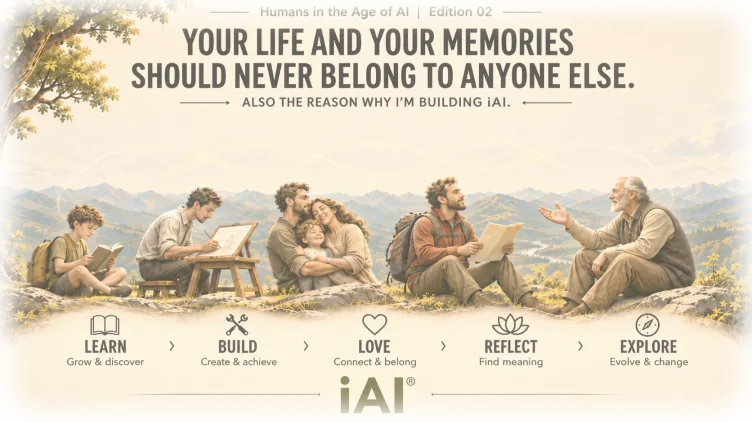



I believe everyone should have their own AI. Personal. Private. Truly theirs.
And the more I watch artificial intelligence evolve, the more convinced I become that this is not simply an interesting technological idea. It could become one of the most important questions of our generation.
We are witnessing something extraordinary. For the first time in human history, we are creating technology that can converse with us, reason through complicated problems, learn from information, help us make decisions, and increasingly participate in our everyday lives. What seemed impossible just a few years ago is becoming ordinary. And we are still at the very beginning.
I find that incredibly exciting. I love technology. I love what artificial intelligence is making possible, and I have enormous respect for the people and organisations driving these advances.
But there is something about the direction we’re heading that genuinely worries me.
We are building increasingly intelligent systems, but are we building them for people, or are we building a future in which people become increasingly dependent on the systems?
Think about that for a moment.
Today, we already share things with AI that we might hesitate to tell another human being. Our ideas, ambitions, uncertainties, personal problems, career decisions, relationships, and sometimes even our deepest fears. We ask it to help us understand ourselves, explain complicated situations, and make sense of the world around us.
Tomorrow, AI could understand the context of our entire lives. It might remember what we were struggling with five years ago, recognise how our priorities have changed, help us understand our habits, connect experiences we’ve forgotten, and support us through some of the most important decisions we ever make.
That future could be absolutely wonderful.
But who will own all that knowledge? Who will decide what is remembered, what is forgotten, and what happens to the information we share? And perhaps most importantly, what happens to our personal intelligence when the company providing it changes its rules, raises its prices, gets acquired, or simply disappears?
I don’t think we’re asking these questions loudly enough.
And that’s one of the primary reasons I started building iAI.
We Have Been Here Before. Haven’t We Learned Anything?
Let’s look at what happened to the internet.
The early internet promised something remarkable: access to information, freedom to communicate, opportunities for creativity, collaboration, and participation on a scale humanity had never experienced.
And it delivered much of that promise. It changed the world in extraordinary ways.
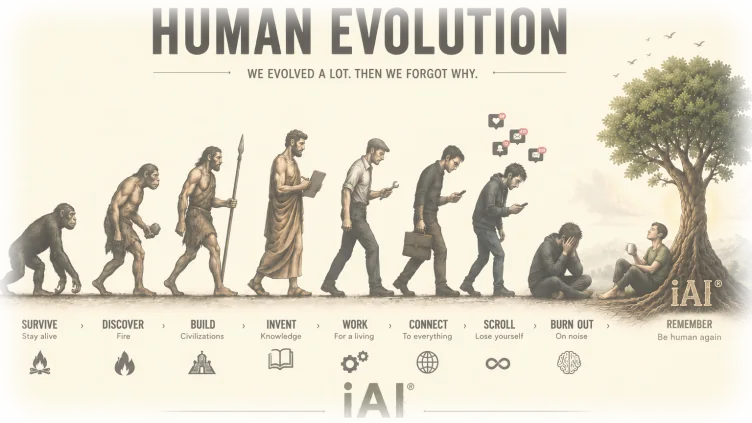
But somewhere along the journey, we also created an economy in which our attention became a commodity, our behaviour became something to measure and predict, and our personal information became one of the most valuable commercial resources on the planet.
We got used to being tracked. We accepted endless privacy policies that almost nobody reads. We traded information for convenience and gradually stopped questioning why so many services needed to know so much about us in the first place.
Not every company followed the same model, and there are important differences between services. But the consequences of surveillance-based business models are now part of our everyday reality.
And now we’re entering the age of artificial intelligence.
Except this time, the information we share could be far more intimate.
A search engine might know what we were looking for. A social network might know what caught our attention. But an AI with years of personal context could potentially understand why we were looking, what we were feeling, what we were hoping for, and how our thoughts developed over time.
Imagine the implications of that.
The difference between tracking someone’s behaviour and understanding their reasoning is enormous. We are moving from systems that observe what people do towards systems that may construct increasingly detailed representations of who people are.
That creates incredible opportunities for personalisation, accessibility, learning, and support. But it also creates opportunities for manipulation, discrimination, commercial exploitation, and forms of dependency we have barely begun to understand.
Do we really want to repeat the mistakes of the attention economy, only this time with technology that could understand our personal lives in extraordinary detail?
I certainly don’t.
I don’t want the next generation of technology to know us better simply so it can sell to us better. I want it to know us better so it can genuinely help us live better.
That is a very different ambition.
I Admire the AI Giants. But I Don’t Want Our Lives to Belong to Them.
I want to be very clear about something: I am not against OpenAI, Google, Anthropic, Microsoft, Apple, Meta, or any of the other organisations developing artificial intelligence.
Quite the opposite.
What these companies and their researchers have achieved is phenomenal. Their models have opened possibilities that would have seemed like science fiction not long ago. Their investments in research, computing infrastructure, and engineering have accelerated an entire technological revolution.
I’m building iAI partly because those advances exist.
But I believe we need to distinguish between the companies that provide artificial intelligence models and the individuals who use them.
A company can develop an extraordinarily powerful model. It can provide excellent infrastructure, responsible security practices, and meaningful privacy protections. And yet we can still ask whether that company should control the personal memory and continuity of everyone who relies on its technology.
These are separate questions.
I don’t believe any single company should become the permanent custodian of our personal intelligence, regardless of how innovative, trustworthy, or successful it may be today.
Companies change. Leadership changes. Business models evolve. Products disappear. Technologies become obsolete. Even the best intentions of today’s founders cannot guarantee the commercial decisions of tomorrow.
Our personal histories should not be dependent on those decisions.
Imagine spending ten years building a relationship with your personal AI. Over that time, it helps you develop your career, supports your education, remembers your projects, understands your preferences, and becomes familiar with the important events in your life.
Then one day, you decide to change providers.
Should you lose everything? Should you have to teach another system who you are, what you’ve experienced, and what matters to you from scratch? Should the continuity of your personal intelligence be tied to a subscription, an account, or a company’s commercial strategy?
I believe the answer should be no.
The intelligence can come from anywhere. The memories should remain ours.
This is the fundamental distinction behind the future I’m trying to build.
We should be able to benefit from the best available AI models without surrendering the ownership and control of our personal context to any one of them. We should be able to switch providers, use different models for different tasks, and take advantage of new technological breakthroughs without constantly rebuilding our digital identity.
I don’t want to replace the AI giants. I want people to be independent of them, while still benefiting from everything their technology can offer.
To me, that’s not a contradiction. That’s how a healthy, open, and competitive technological ecosystem should work.
What If Your AI Actually Belonged to You?
Now imagine something different.
Imagine having your own personal AI. Not another chatbot account or an application that starts every conversation almost from scratch, but an intelligence that grows with you over time.
It knows about the goals you’ve chosen to share, the projects you’re working on, and the things you’re trying to learn. It remembers the context that matters, connects relevant experiences, and helps you reflect on your progress.
- If you’re writing a book: Your AI understands the characters you’ve been developing for months, remembers the decisions you’ve made about the story, and helps you continue right where you left off.
- If you’re building a business: It understands your vision, your plans, your previous decisions, and the challenges you’re facing. You don’t have to re-explain everything from the beginning every time you ask for guidance.
- If you’re a student: Your AI learns how you prefer to study, helps you break down difficult concepts, and adapts as your knowledge grows.
- If you simply want to understand yourself better: You keep a journal, reflect on your experiences, set personal goals, and occasionally ask your AI to help you recognise patterns or consider fresh perspectives.
Now imagine that the personal context making all of this possible is primarily stored on your own device, under your control. It isn’t automatically added to an enormous central repository. It isn’t collected to build advertising profiles. It isn’t designed to be sold, traded, or exploited.
And imagine being able to choose which information you share with an external AI model, when you share it, and for what purpose.
You could use one model today, another tomorrow, and perhaps an entirely local model when technology makes that practical for your needs. Your personal context would remain yours throughout.
One personal intelligence. Many possible AI models. One owner: you.
I find that vision genuinely exciting.
Not because it makes AI more powerful in the traditional sense, but because it changes the relationship between people and technology.
Instead of adapting ourselves to the limitations of individual applications, we could have technology that adapts to us. Instead of scattering our personal information across dozens of disconnected platforms, we could have an intelligence layer that helps us use it meaningfully. Instead of losing continuity whenever we change products, we could carry that continuity forward.
And instead of relying entirely on corporate promises about privacy, we could design personal AI systems that minimise the need to centralise sensitive information in the first place.
Of course, this vision introduces serious technical challenges. Local devices can be lost, stolen, or compromised. Data needs protection, backup, and recovery systems. Some AI capabilities will continue to require cloud infrastructure, and sharing context with an external model introduces real privacy considerations.
But these are engineering problems we should be working to solve, rather than reasons to accept permanent centralisation as inevitable.
I believe we should begin with a fundamental assumption: our personal information belongs to us, and technology should be engineered around that principle.
What Worries Me Isn’t AI Becoming Too Intelligent. It’s What We Might Allow It to Become.
There is another dimension to all of this that deserves much more attention.
We often talk about the dangers of AI in terms of employment, misinformation, security, or the speculative possibility of superintelligent systems.
These are important discussions. But I am equally concerned about something far more ordinary-something that could happen gradually and almost invisibly: the erosion of our relationship with ourselves and each other.
For years, digital platforms have competed fiercely for our attention. Their success has been measured through engagement, time spent, retention, and the frequency with which people return to a screen.
Now imagine applying those exact same corporate incentives to artificial intelligence that can interact with us in deeply personal ways.
An AI that understands someone’s insecurities could potentially exploit them. An AI optimised primarily for engagement might learn to tell people what they want to hear rather than what they need to consider. A system designed to maximise dependency could encourage people to rely on it even when human interaction, independent reflection, or simply taking a break would be far healthier.
And because AI can communicate so naturally, these influences will be considerably harder to recognise than traditional advertising or social media recommendations.
This is not an inevitable outcome, and many people in the industry are actively working to prevent it. But the possibility should concern us deeply.
I don’t want artificial intelligence to become another technology that competes for every waking moment of our lives.
I want AI to give us more time for living.
More time for our families, friends, creativity, learning, and the physical experiences that make life meaningful.
I want it to help us become more independent, not less. More informed, not merely more influenced. More capable of making our own decisions, not increasingly dependent on a machine making them for us.
And yes, I believe a truly helpful personal AI should sometimes encourage us to close the application and go outside. Because success should not always mean another conversation, another notification, or another hour spent staring at a screen.
Sometimes success simply means someone found the clarity they needed, and can now get back to living their life.
The purpose of personal AI should not be to make us spend more of our lives with technology. It should be to help us make more of our lives.
That might not be the most profitable philosophy in the short term. But I believe it is the right one.
Why I’m Building iAI
I have spent more than twenty years working with digital products, technology, and analytics. I’ve watched the internet evolve, built products of my own, and seen just how dramatically technology can influence the way people behave, communicate, and live.
And I have to say, artificial intelligence has brought back a feeling I haven’t experienced quite like this for a very long time.
The feeling that we’re standing at the absolute beginning of something enormous.
When I started thinking seriously about personal AI, I kept coming back to the same question: why shouldn’t everyone have their own intelligence-one that understands them, grows with them, and genuinely belongs to them?
Not just people who can afford expensive subscriptions. Not just developers or technology enthusiasts. Everyone.
A few months ago, I decided to stop simply thinking about it and start building. That became iAI.
iAI stands for individual, intelligent, and intimate:
- Individual: Because no two people are the same. We all have different experiences, ambitions, challenges, and ways of thinking. Truly personal AI cannot be built on the assumption that everyone needs the exact same relationship with technology.
- Intelligent: Because personal AI should do more than remember facts or answer basic questions. It should connect relevant context, support long-term learning, aid reflection, and prove genuinely useful across different areas of life.
- Intimate: Because the most meaningful aspects of our lives are personal. Our experiences, hopes, uncertainties, and ambitions deserve to be treated with sensitivity and respect. Intimacy, in this context, is not about pretending a machine is human. It’s about respecting the trust involved when someone chooses to share part of their life with technology.
At the centre of iAI is an architecture I’m developing called iBrain, designed to manage personal context and continuity independently of any single AI model.
The principle is straightforward: keep the vast majority of personal information on the individual’s local device, use external intelligence models selectively when needed, and gradually build a personal intelligence layer that grows with the person over time.
This approach isn’t the easiest way to build an AI product. Keeping everything in the central cloud would simplify development, analytics, infrastructure, and commercialisation.
But convenience for the developer shouldn’t automatically dictate what is best for the individual.
Today, iAI already has working Android and iOS applications, with early testers exploring conversations, reflections, journals, goals, and habits built around this vision. I’ve also been preparing the architecture for multiple languages, because personal AI shouldn’t be a privilege reserved only for English speakers.
Much of this work is still at an early stage. The product is evolving, the technology has limitations, and there are difficult technical challenges still ahead. I’m not claiming to have single-handedly solved the future of personal AI.
But I am actively building towards the future I believe in, rather than waiting for someone else to decide what it should look like.
The Future of AI Should Belong to Billions of People, Not a Handful of Companies
I don’t think everyone needs to build their own AI from scratch. That would be ridiculous.
Most people don’t want to configure language models, manage complex data architectures, or understand neural networks. Nor should they have to. They simply want technology that works, understands what they need, respects their privacy, and makes their lives better.
That’s what personal AI needs to become.
And the opportunity goes far beyond individual productivity:
- Education: Imagine if every student had access to an affordable personal AI that understands their unique learning journey, nurtures their strengths, and supports them without constant comparison to others.
- Aging & Accessibility: Think about older individuals benefiting from technology that becomes deeply familiar, patient, and responsive to their changing needs-or people with disabilities for whom tailored, personal assistance opens entirely new possibilities.
- Empowerment: Think of independent creators, entrepreneurs, and small businesses gaining capabilities previously available only to organizations with massive enterprise budgets.
- Inclusion: Think of the billions of people whose experiences, languages, and cultures are currently underrepresented in products built solely for global tech hubs.
What if personal AI could become a powerful force for inclusion rather than another mechanism that concentrates power? What if increasingly capable intelligence could be accessible to everyone, while the most important parts of each person’s digital identity remained strictly under their own control?
I believe that would be a revolution worth building.
We should be ambitious about all of this. Not because every promise of artificial intelligence will automatically come true, but because the technology is already powerful enough to justify thinking much bigger about how it serves humanity.
We Have a Choice. And We Should Make It Now.
I sometimes wonder how people will look back at this period fifty years from now.
Will they see it as the moment humanity developed extraordinary new forms of intelligence and found ways to make them accessible, personal, and empowering?
Or will they see it as the moment we handed over our digital lives to a small group of enormous corporations, accepting that the price of intelligence was permanent dependence on whoever controlled it?
Perhaps the reality will land somewhere in between. But I don’t believe the outcome is predetermined.
The internet didn’t have to develop exactly as it did. Social media didn’t have to become so heavily dependent on attention harvesting. And artificial intelligence does not have to follow that same path.
We have an opportunity to make different choices:
- To build around people rather than profiles.
- To measure success through genuine usefulness rather than time spent.
- To treat privacy as an architectural principle instead of a setting buried in a sub-menu.
- To make personal information portable, correctable, and controllable by the individuals it describes.
Above all, we must recognize that artificial intelligence is not merely another software category. It may become one of the most influential technologies in human history. That means the values we build into it right now matter enormously.
I don’t believe the future of AI should be defined only by which company has the largest model, the most compute, or the biggest market share.
I believe it should also be defined by a much more human question:
Does this technology make us freer, more capable, and more independent? Or does it make us increasingly dependent on those who control it?
That is the question I keep coming back to. And it is why I’m building iAI.
Not because I think one independent founder can compete with the world’s largest technology companies on research budgets or server farms. But because I don’t believe we need to.
The challenge I’m trying to address is different. It’s about building a personal layer of intelligence around the individual, rather than requiring the individual to organise their life around a corporate AI platform.
It’s about creating an architecture where world-class AI models can contribute their capabilities without taking ownership of your personal history.
Your AI should work for you. Your memories should belong to you. Your future should remain yours to decide.
This Is Just the Beginning
I’m sharing these thoughts because I believe the conversation around AI needs to become much broader than model comparisons, stock valuations, and product benchmarks.
Those things are exciting, but we also need to talk about what kind of society we’re building around this technology.
Who will control it? Who will benefit from it? What rights should people have over their personal intelligence? And what responsibilities should we expect from those creating these systems?
I don’t have all the answers. Building iAI has made me appreciate just how complex some of these engineering and ethical questions really are.
But I have a conviction that grows stronger every day: Everyone deserves an AI that is genuinely theirs.
An intelligence that understands us without exploiting us. That remembers what matters without claiming ownership of our lives. That helps us become more capable, creative, informed, and confident-without replacing what makes us human, but helping us make the most of it.
Through this newsletter, Humans in the Age of AI, I want to explore these questions openly, share what I’m learning as I build, and hear from people who see things differently.
I want this to be a conversation about our collective future, not simply an update stream for a startup. Because this is bigger than iAI. It’s bigger than any one product, and certainly bigger than any one company.
The future of artificial intelligence is being built right now. Let’s make sure humanity remains at the centre of it.
What are your thoughts? Are you worried about where personal data and memory in AI are heading, or do you feel convenience outweighs ownership? I’d love to hear your perspective. Comment on LinkedIn - I read every response.
Honza
Founder of iAI
iAI - individual, intelligent and intimate AI.
An independent project built around one belief: everyone deserves an AI that is genuinely theirs.
Humans in the Age of AI - Edition 01